

Genealogical Study of Russian Authorities
Project contributors:
Vitaly Soldatskikh, Ekaterina Reznikova, Roman Badanin, Mikhail Maglov, Mikhail Rubin, Katya Arenina, Roman Romanovsky, Leonid Pimenov, Alexander Savelyev, Elizaveta Tsybulina, Andrei Zatirko, Alexei Korostelev, Roman Kovalenko, Alexander Ternavsky, Boris Dubakh, Nadezhda Makeeva, and other authors and designers. In participance with Rupep.org and Protocol media

In early 2025, Russians might have seen a bizarre TV report about Deputy Prime Minister Dmitry Patrushev’s visit to the Bryansk Oblast. Despite his status, the distinguished guest from Moscow, stood behind two other visitors with the same surname, Nikolai and Viktor Patrushev. These are the father and uncle of the Russian Deputy Prime Minister, and they also hold important government posts, so the visit to Bryansk was like a family trip. The trio was given a tour by local governor Alexander Bogomaz, whose five relatives control almost the entire agricultural sector in the Bryansk Oblast and also hold positions in local government. You got this right: one ruling dynasty was meeting another. What you will read and see below is truly frightening: Putin’s regime is reproducing itself, with the old guard being replaced by their heirs and the heirs of their heirs. We bring you the first genealogical study of Putin’s court.

In 2003, Olga Kryshtanovskaya, a sociologist from the Academy of Sciences, presented the first major study of Putin’s court. Her research team studied the biographies of 3,500 officials working in government bodies, all the way from the Kremlin to the regions 
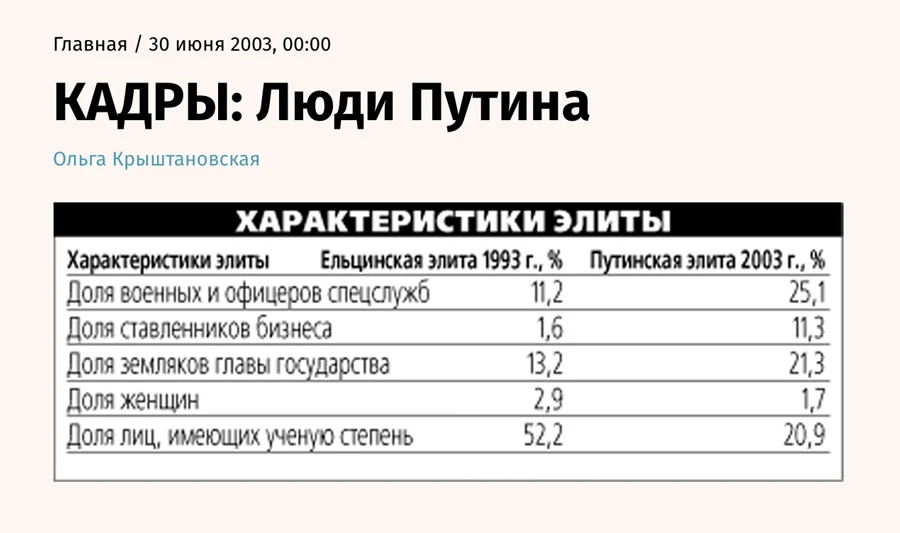
The sociologist was frequently cited and interviewed by media that had not yet been affected by censorship. She spoke about the dangers of letting security officials run the country, the risks of authoritarianism, and other insightful topics. Then, unexpectedly, she joined United Russia, and shortly thereafter became Putin’s trusted representative in the 2012 elections. Many people were shocked by this transformation. As Kryshtanovskaya said years later, joining the ruling party was a “research operation” for her—a way to study the subject from the inside. Kryshanovskaya left United Russia in the fall of 2012. Upon her departure from Putin’s party, the sociologist made an accurate prediction: “[The bureaucracy] now has the opportunity to transform itself into a hereditary aristocracy”
For the past year and a half, Proekt’s team has been conducting its own research into Putin’s nomenclature.
Who are Putin’s top officials, and why them? What role did family ties play in their careers? How important were their connections? Or their affiliation with the special services? Finally, what are these people hiding from the public?
We have studied the biographies of approximately 10,000 officials and their relatives, compiling dossiers on those civil servants who probably got their positions thanks to their fathers and grandfathers, or who got their spouses, children, grandchildren, and other relatives into civil service or high-paying positions in budgetary organizations, or perhaps helped them start businesses that thrive on government contracts.
Study methodology in detail
Who did we study?
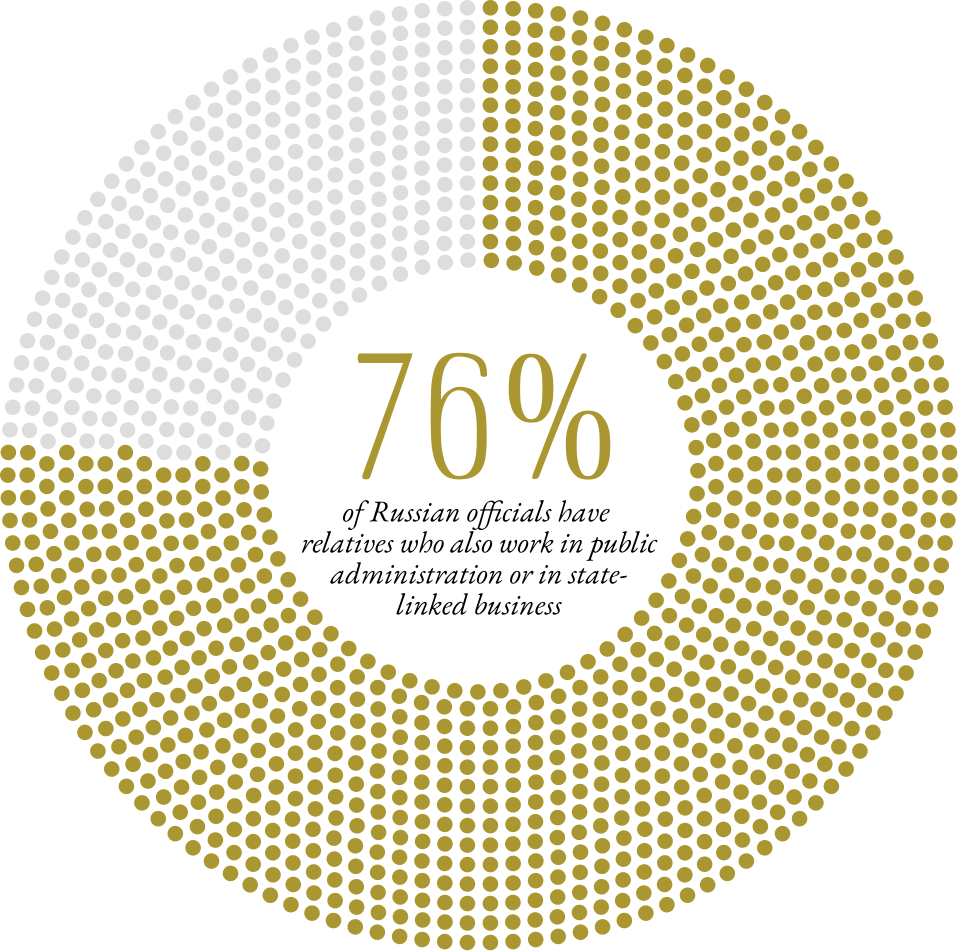
We studied the biographies of 1,329 people holding positions in Russia in all major areas of public administration, from the highest authorities to the largest state-funded museums. As you will read below, we discovered that 76% of them (1,012 people) had relatives either also employed in public administration, or in businesses connected to government agencies, or in public work funded by the budget or political parties (all of which are subordinate to the Kremlin to one degree or another), or display other signs of potential conflicts of interest (for example, working in private companies in the same field as the interests lobbied by a relative who is a government official). We estimate the average number of relatives of each civil servant we studied to be eight, which brings the total amount of biographies studied by us to about 10,000.
The full list of government structures and their employees that we studied is as follows:
Kremlin
President and members of the Security Council
Head of the Presidential Administration (AP)
Deputy Heads of the AP
Presidential aides and advisers
Presidential envoys and special representatives
Heads of AP departments
Deputy Heads of AP departments
Head of the Administrative Directorate of the President of the Russian Federation
Deputy Heads of the Administrative Directorate
Department Heads
Government
Prime Minister
Deputy Prime Ministers
Ministers
Deputy Ministers
Federal Services and Agencies
44 agencies, excluding law enforcement
Heads and, in some cases, deputy heads
Federal subjects of the Russian Federation
Governors and heads of republics
Heads of annexed Ukrainian regions appointed by the Russian authorities
Federal Assembly
179 members of the Federation Council
443 deputies of the State Duma
*Some seats in both chambers of parliament remained vacant at the time of the study
Judicial authorities
All members of the Constitutional Court
Presidium of the Supreme Court
Law enforcement and security services
National Guard (Rosgvardiya) — head and deputy heads
Prosecutor General’s Office — head and deputy heads
Foreign Intelligence Service (SVR) — head and deputy heads
Main Intelligence Directorate (GRU) — head and deputy heads
Ministry of Internal Affairs — minister and deputy heads
Ministry of Justice — minister and deputy ministers
Federal Penitentiary Service (FSIN)— head and deputy heads
Federal Protective Service (FSO) — head and deputy heads
Investigative Committee — chairman, deputy chairmen, head of the Main Investigative Directorate
Federal Security Service (FSB) — director, deputy directors, heads of directorates
Central Election Commission
Members with consultative vote rights
Accounts Chamber
Board
Auditors
Civic Chamber
Secretary
Bank of Russia
Board of Directors
State-owned companies, corporations, major state universities, media, museums, etc.
Heads of major organizations (selectively)
Primate of the Russian Orthodox Church
What were we looking for?
In the broadest sense, we investigated the existence of family ties among Russian authorities, attempting to answer the question, “Are they passing the country down through generations?” Family ties here refer to any degree of kinship (blood relatives of any generation, spouses, in-laws). In some cases, the study also covered informal relationships – godparents and godchildren, lovers/mistresses and civil partners, and in particularly rare cases, people from the same geographic area – in all these cases, the basis for inclusion in the database was the proven particular closeness and trust between the individuals involved (in all such cases, we specifically indicate the reason for inclusion).
The grounds for inclusion in the database were:
a) A relative working in any government agency.
b) A relative working in the public sector of the economy in managerial positions.
c) A relative working in the private sector of the economy if there are signs of a conflict of interest (receiving government contracts; the same sphere that the official is involved in lobbying and controlling, etc.).
d) A relative working in a senior position or having a business partnership with large oligarchic structures closely linked to the Russian authorities (e.g., the father of an MP being a business partner of Oleg Deripaska, a top manager of Alisher Usmanov’s company, etc.). In most cases known to us, major players in Russian business are closely linked to the authorities and often corrupt officials by paying salaries and dividends to their relatives. Another sign of a conflict of interest for us was the relatives of a civil servant having a common business with other officials or their families (this often indicates that the person is a nominal owner of the asset in the interests of their power-holding relative).
e) A relative working in a public structure (foundations, NGOs, civic chambers, etc.) that is financed by the state or political parties and is under the explicit or implicit control of the executive branch.
f) A relative working in a managerial position in a budgetary institution accountable to a member of their family (universities, research institutes, museums, medical institutions, etc.).
g) A relative serving in the army or any other law enforcement agency with an officer’s rank.
h) There may also be some special cases, including but not limited to proven favoritism toward a relative of an official when applying to a prestigious university or covering up for a relative of a civil servant who committed a criminal offense. In all such cases, the context of the events is provided in the bios.
As part of the study, we also examined several related issues:
a) Whether the officials in question have experience of service in law enforcement agencies (this also includes obtaining an officer’s rank through training at a military university, service in irregular formations (Cossack troops, DPR/LPR military units, etc.), proven cooperation with special services, possession of an officer’s rank or departmental awards for special, unofficially disclosed services to law enforcement agencies (e.g., for cooperation with the SVR, KGB, etc.).
b) Whether they have experience of working/serving in the Soviet state apparatus in positions of some prominence (leadership of the CPSU and Komsomol, trade unions, large-scale industry, agriculture, etc.)
c) Whether they own real estate and, in some cases, other expensive property, the origin of which can be related to corruption.
d) Connections between the officials and foreign countries, in cases where we have such information (family members studying abroad, foreign citizenship and residence permits, real estate in third countries, repeated tourist trips to countries that are officially recognized as unfriendly by the Russian Federation).
What period does our study cover?
We examined the family ties of civil servants who held their positions as of January 1, 2025. In cases where an official lost their position (and sometimes their life) after that date, we noted this fact separately in their bio.
We included the relatives in our study if a career or financial conflict of interest existed between them and the official at any point in the latter’s career. For example, one of Vladimir Putin’s former sons-in-law, Kirill Shamalov, had a conflict of interest with his high-ranking relative at the time when he was married (in a civil marriage) to the president’s daughter, Katerina Tikhonova. After the divorce, he lost a significant portion of his assets and his position at Putin’s court, but he was nevertheless included in our study, as his career success and wealth were all attributable to his father-in-law’s patronage during the period when the latter held public office.
We also included those relatives whose high position in the state hierarchy of the past probably also guaranteed the success of their descendants in public service. This applies to all bureaucratic dynasties that began in Soviet times or even earlier, in tsarist Russia.
What methods did we use to study biographies?
Establishing that a person holds a government position in today’s Russia is not as straightforward as one might think. Fear of sanctions, the traditional secrecy of the Russian authorities, special secrecy orders and other reasons have led to a situation where, in some cases, agencies and companies do not even disclose the names of their leaders. To compile an up-to-date list of people holding various top positions in the public sector, we used the official websites of institutions and organizations, the most recent publicly available phone directories for these structures, public data, and media reports. In some cases, even that was not enough, and we had to resort to more complex methods. For example, to find out the names of the deputy heads of the Presidential Administration (which are not publicly disclosed), we analyzed various regulatory acts (such as orders on awards and incentives) and used publicly available leaked correspondence.
To find relatives of officials, we used a whole range of OSINT methods in addition to open data:
a) we studied people who had lived at the same addresses as the officials for the last 35 years.
b) we analyzed databases that collect information about the shared use of cars, phones, and email addresses.
c) we reviewed leaks about regular joint crossings of the state border, which usually indicates the existence of personal relationships between people.
d) we studied leaks from the civil registar’s office.
To analyze the biographies of officials’ relatives, we searched for information as follows:
a) we established the existence of financial and any other professional relationships with a state employer (using leaks containing tax data, workplaces data, and in some cases, employment record book entries).
b) We studied telephone directories indicating the subscribers’ positions and titles.
c) we used thematic databases compiled by independent researchers before us (rupep.org, dumabingo.org, declarator.org, etc.)
d) we obtained archival extracts when necessary and possible.
e) in some cases, we relied on conversations with colleagues of the officials and other sources.
f) we used official business registers to study the entrepreneurial activities of the study subjects.
g) we studied officials’ public income and property declarations.
Necessary disclaimers
First and foremost: We do not claim that there is a conflict of interest in all cases of kinship described in our study. In many cases, we cannot claim that the offspring of an official’s family obtained their position and wealth solely due to their origin or the patronage of one of their parents. In a few isolated cases, we can say with a high degree of certainty that the career of such an offspring was definitely not influenced by their family ties (e.g., a mother who is a top government official and a son who is the head of a state-funded medical institution and began his career as a doctor). However, all such cases identified by us are still included in the database because, among other things, they illustrate the interrelationships within the Russian leadership. We apologize to those relatives of the subjects of our study who work and earn their living honestly and do not want to be associated with members of their family who work for Vladimir Putin’s regime.
Second: Many of the sources (primarily data leaks) on which we relied are fragmentary and unsystematic. They contain errors. Inaccuracies and deliberate falsehoods are also present in open data and media reports. We took these factors into account, trying to verify controversial facts by relying on two or more documents, in particularly important cases, we checked hypotheses about kinship using sources on the “data mining” market, and so on. Despite all this, inaccuracies are still possible in our database. They can be of two types: a) we included a relative in the study, mistaking them for a public official; b) we mistakenly did not include a relative in the study because data about them had been removed from databases and the media.
Therefore, we reserve the right to make further changes to our database. We welcome reader feedback and would be grateful for any information that may be useful.
Third: When writing the bios, we were occasionally forced to use information from “non-traditional” media outlets—anonymous Telegram channels and websites specializing in reprinting “blackmail material.” In some cases, us quoting such sources is explained by censorship and the removal of original articles from web search engines (read more about problems with access to information here). In all such cases, we indicated in the text that the source of information does not comply with journalistic standards.
Fourth: For the convenience of our readers, we omitted legal nuances in the names of various categories of government officials. In most cases, we use the terms “civil servant” and “official.”
Fifth: For the convenience of our readers, in some cases we have simplified the terms for specific family relationships (for example, to refer to an aunt by marriage (i.e., not related by blood to the subject’s uncle’s wife), we used the term “aunt,” etc.). In cases where we were unsure of the exact nature of the relationship, we used the terms “relative” and “inlaw”
Sixth: For methodological reasons, we did not include certain categories of important civil servants in the study. For example, members of the governments of large and wealthy regions, such as Moscow and St. Petersburg, were not included. Nepotism and conflicts of interest are also prevalent among these officials, but it would not have been possible to study the biographies of all vice governors and ministers in all regions of Russia as part of our special project.
How to use our database?
The database is structured in an intuitive way. Users can search for officials and their relatives in alphabetical order or by subject area (Kremlin, government, security forces, State Duma, Federation Council, etc.).
In cases where the family trees of officials from different departments intersect (for example, the rector of one of Russia’s most significant universities, MIPT, former Minister of Education Dmitry Livanov is related to Senator and another former member of the government Dmitry Rogozin), the full bio is provided in the section dedicated to the main place of work of the person in question (Livanov’s is in the MIPT section, Rogozin’s is in the Federation Council section).
This pictogram ★ in an official’s bio indicates that he or she holds an officer’s rank or works in any of the security or law enforcement agencies.
The database does not include the names and positions of those officials whose biographies did not reveal any signs of nepotism or conflict of interest. We studied the biographies of 1,329 civil servants and found that 1,012 of them had relatives in government or state-affiliated spheres. If you know for certain that some official who is not included in our database has arranged a government position for someone close to them, please contact us at nepotism@proekt.media.
We are passed down through generations
Key findings of the study in brief
The main conclusion of our study can be summed up in one figure: 76%. That is the percentage of senior Russian civil servants with relatives who are also employed in public administration or in businesses affiliated with the government. This is a huge proportion—three out of every four Russian leaders either follow in the footsteps of other officials or have arranged for their descendants to live at the expense of the state.
Unfortunately, we have nothing to compare our findings with, as no one has previously studied the biographies of Putin’s elite in this context. However, we can compare the “nepotism index” in different government bodies.
Federation Council
86%
State Duma
84%
Kremlin
74%
Security forces and judges
74%
Governors
69%
Government
61%
*We included the Ministry of Internal Affairs, the Ministry of Justice, and the Ministry of Defense, as well as security services (in particular, the FSB, FSO, and SVR) in the “Security Forces and Judges” category. The Ministry of Emergency Situations was included in the “Government” category.
** The Security Council is registered in the “Kremlin” category with three members who do not hold other positions. The remaining members are registered at their primary place of service.
Details for each government agency
The percentage of senior Russian government officials who have relatives who are also employed in government administration or government-related businesses in the government agencies included in our study:
Administrative Directorate of the President
85%
Presidential Administration
68%
Federation Council
86%
State Duma
84%
Prime Minister, Deputy Prime Ministers
91%
Ministry of Industry and Trade
83%
Ministry of Labor
83%
Ministry of Construction
80%
Ministry for the Development of the Russian Far East and Arctic
75%
Ministry of Finance
70%
Ministry of Agriculture
67%
Government agencies and services
66%
Ministry of Sport
60%
Ministry of Foreign Affairs
58%
Ministry of Economic Development
58%
Ministry of Emergency Situations
56%
Ministry of Culture
50%
Ministry of Natural Resources and Environment
50%
Ministry of Transport
44%
Ministry of Education
43%
Ministry of Health
36%
Ministry of Digital Development
36%
Ministry of Science and Higher Education
33%
Russian Direct Investment Fund
100%
Accounts Chamber
77%
Central Election Commission
60%
Federal Financial Monitoring Service (Rosfinmonitoring)
57%
Supreme Court
100%
Ministry of Defense
100%
Генпрокуратура
91%
Ministry of Internal Affairs
89%
Federal Security Service (FSO)
86%
Federal Penitentiary Service (FSIN)
83%
Investigative Committee
78%
Federal Bailiff Service (FSSP)
75%
Constitutional Court
73%
Ministry of Justice
70%
FSB
69%
National Guard (Rosgvardiya)
56%
Main Directorate of the General Staff of the GRU
50%
Federal Service for Military-Technical Cooperation (FSVTS)
43%
Foreign Intelligence Service (SVR)
25%
Sberbank
100%
VTB
100%
Gazprombank
100%
Rosselkhozbank
100%
VEB.RF
100%
Rostelecom
100%
Avtodor
100%
Russian Railways
100%
Gazprom
100%
Bank of Russia
92%
Rostec
71%
Rosneft
67%
Rosseti
57%
DOM.RF
0%
Governors
69%
Media and cinema
90%
Key universities and the Russian Academy of Sciences
75%
Museums and theaters
57%
Are ruling dynasties, i.e., groups of people related by kinship who simultaneously hold various important positions (often entering into direct conflicts of interest, where, for example, a father is the immediate superior of his son), forming in Russia? Yes, and there are plenty of such “ruling dynasties.”
Every second official in our sample has more than two relatives who are also involved in public administration. But this is nothing compared to the 25 families in which 10 or more members are
“Ruling dynasties”
25 civil servants with the largest number of relatives employed in public administration or government-related business

96
27
19
16
15
15
13
13
12
12
12
12
11
11
10
10
10
10
10
10
10
10
10
10
10
A significant portion of these dynasties formed in the national republics of the Caucasus. A separate Caucasus ranking of “ruling dynasties” looks as follows
“Ruling dynasties” from the Caucasus
10 civil servants from the Caucasus with the largest number of relatives employed in public administration or state-related business
96
19
13
12
10
9
8
8
8
8
However, such nepotism, known in the Caucasus as tukhumstvo, has also long since spread to other Russian regions. Here is the ranking of dynasties not originating in the Caucasus:
“Ruling dynasties” from other regions
10 civil servants not from the Caucasus with the largest number of relatives employed in public administration or in government-related businesses
25
16
15
15
13
12
12
12
11
11
Finally, another important cross-section in a clear infographic:
Which sectors of the economy are controlled by the families of Putin’s elite
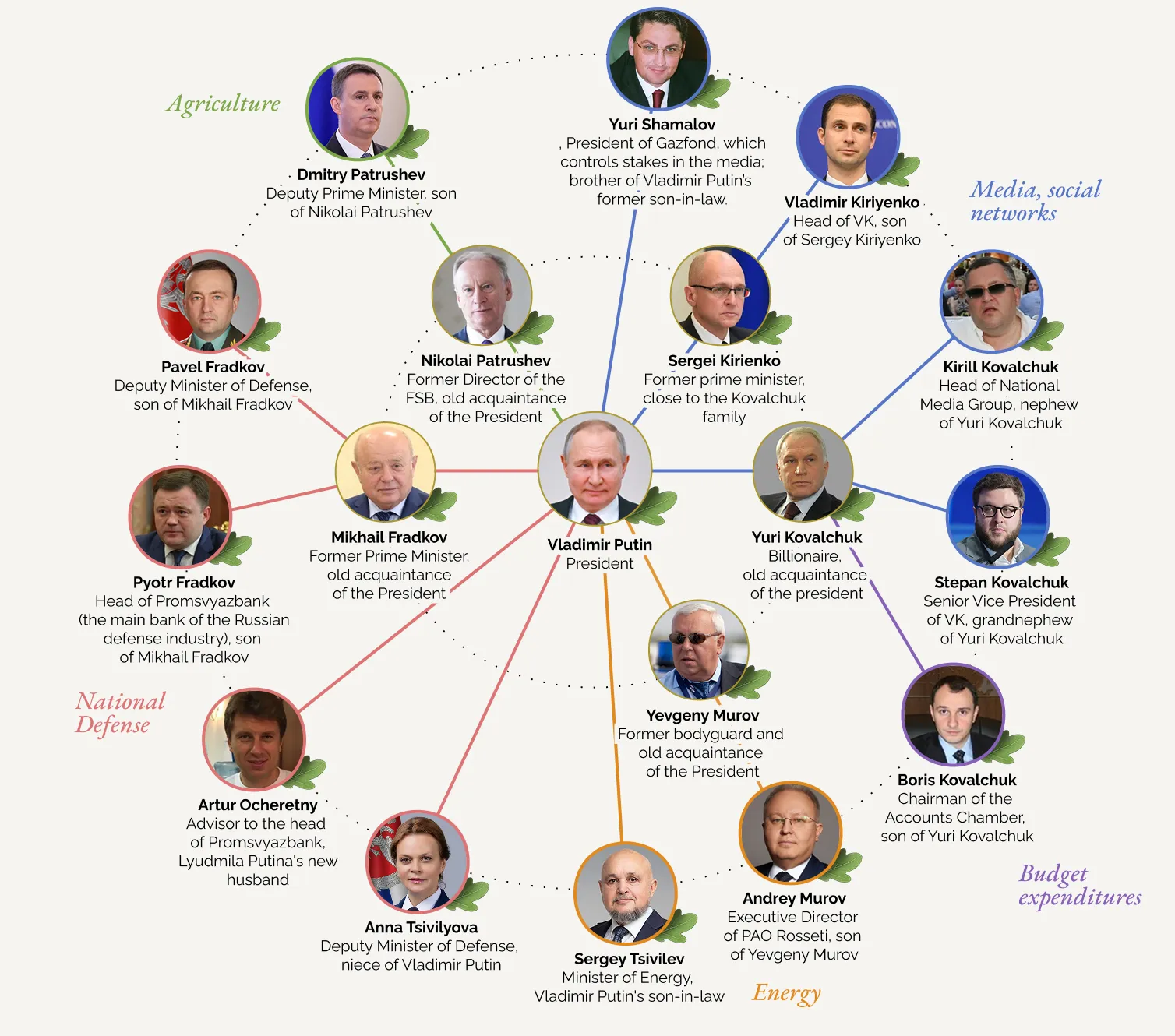
It is also worth showing another infographic here. It shows which oligarchs most often employ relatives of Russian officials
The top 10 includes five businessmen from “Putin’s draft”, friends of the president who became big entrepreneurs under him and often thanks to him. The other five places are occupied by oligarchs who became major players back in the 1990s but managed to maintain their position thanks to their friendship and, in some cases, kinship with Russia’s current leadership.
Oligarchs in Power
12 oligarchs with the largest number of relatives employed in government or state-related businesses
19
11
10
9
9
8
7
7
6
5
5
5
Расследования — это дорого, но это того стоит
Оформив ежемесячное пожертвование «Проекту», вы поможете нам делать еще больше важных и громких расследований. Так вы поддержите всю расследовательскую журналистику в России!
Поддержать «Проект»
How many security officials or “siloviki” are there in the government? Their share has grown even more since Olga Kryshanovskaya’s study 23 years ago—now it is at least
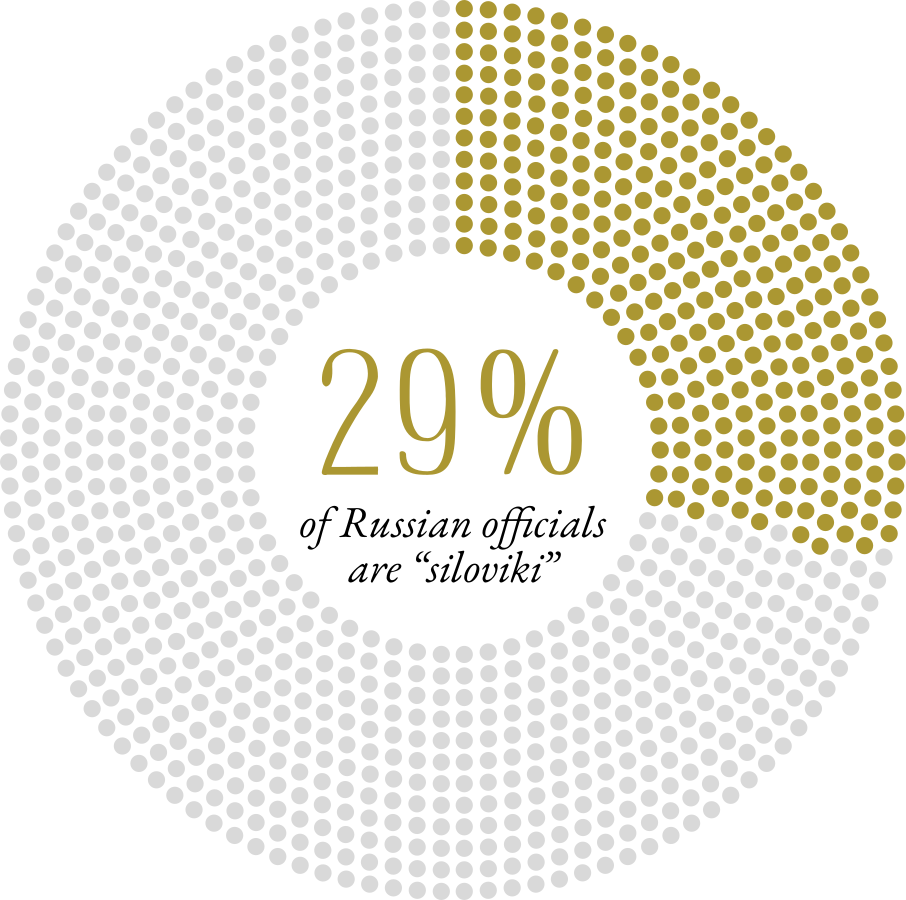
*293 of 1,012 civil servants included in the Proekt sample
If we consider only civil agencies, the percentage of “siloviki” in them will be 21%.
Kremlin
36%
State Duma
23%
Federation Council
23%
Other government agencies
20%
Government
14%
State-owned companies and state-owned banks
14%
Governors
13%
Culture, Science and Media
0%
In addition, 20% of the officials in our sample have “siloviki” among their immediate relatives.
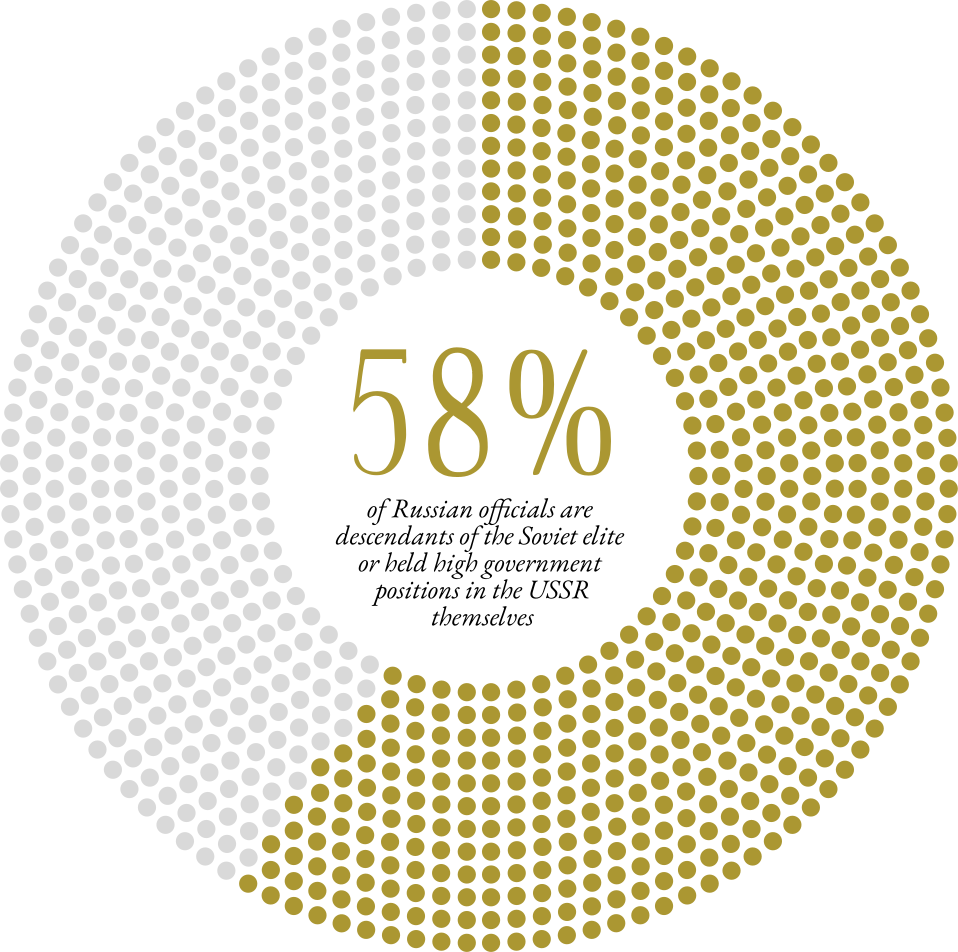
How many incumbent Russian officials are descendants of Soviet bureaucratic dynasties or held high government positions themselves during the Soviet era themselves? More than half — 58%
Federation Council
86
State Duma
84
Kremlin
72
Governors
69
Security forces and judges
67
Government
63
Are there many women in Russian state leadership? Are female leaders involved in nepotism to the same extent as their male colleagues?
Of the 1,329 officials whose biographies we studied, only 15% were women. The representation of women in our final sample is almost proportional to this share – 13% – meaning that Russian female officials are just as prone to nepotism as their male counterparts.
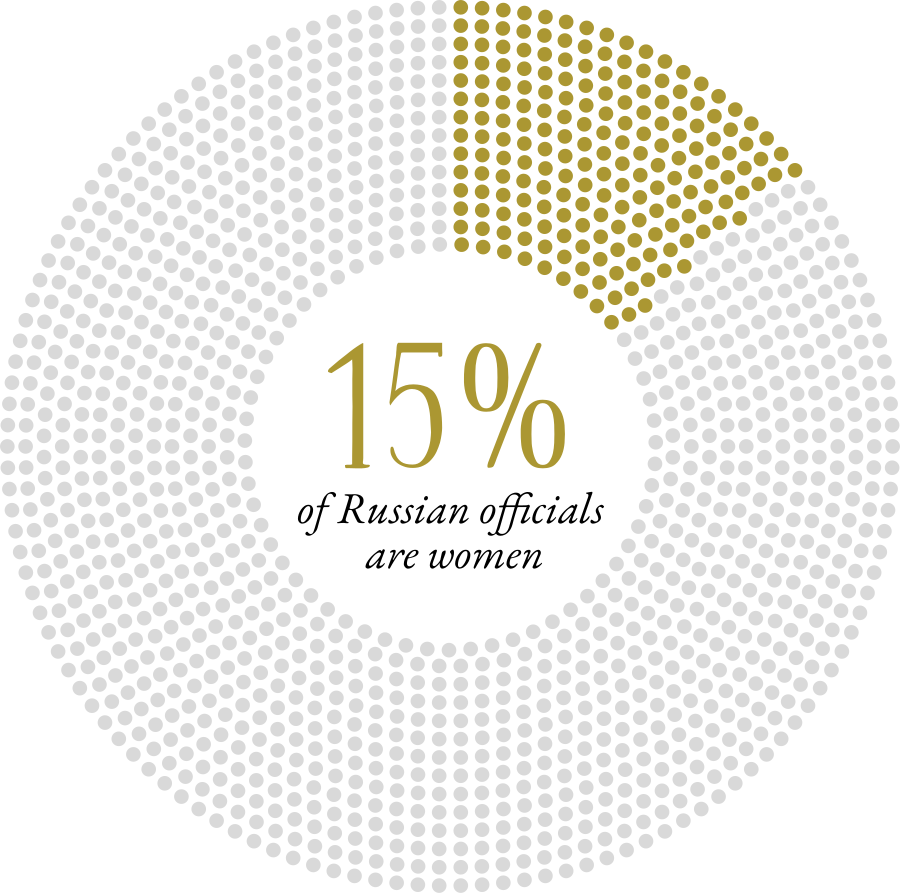
Russia has long lagged far behind global best practices in terms of the number of women in government. Even the UN’s rather conservative recommendations on the adequate representation of women in various national governing bodies vary around 30%.
What percentage of officials have relatives who fought in Ukraine? Less than 1% (10 out of 1012 people in our database).
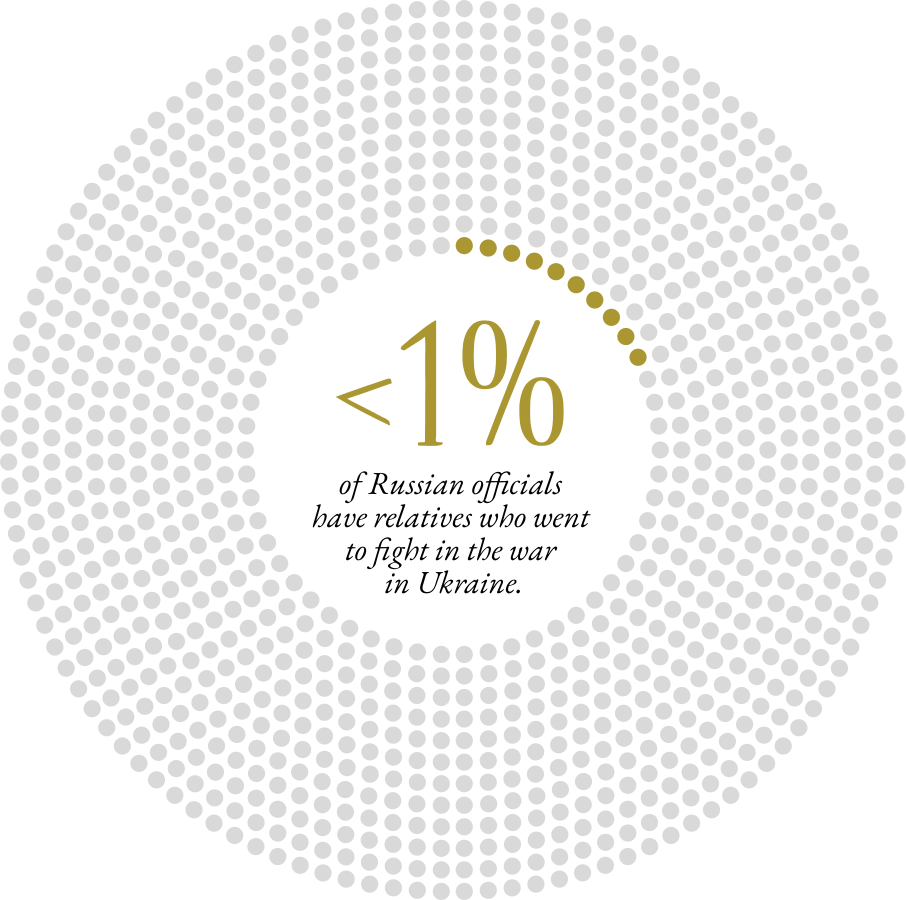
*All representatives of one clan are considered as one official
Are these all the findings of the study? No, throughout the week we will be publishing exclusive stories and investigations based on the facts we have uncovered. What kind of people sit in the Russian parliament and do they really represent their constituents? How did FSB employees get so rich? How do Russian women build their careers in government? Why do officials settle close to each other? How many fictitious divorces and actual mistresses are there at the top? Which government officials spend hundreds of millions of rubles on designer goods? Make sure you reserve enough time to familiarize yourself with all the narrative and graphic parts of our research, as well as to watch the video. This will be worth it. It is always good to know those who rule over us. Especially since, as you can now see, they are going to rule over your descendants as well.